

What Is a Toxic Christian Marriage and How Do You Know You Are In One
What is a toxic Christian Marriage?
If you typed ‘toxic Christian marriage’ into a search bar today, I need you to know something before we go any further.
The fact that you’re asking the question means you already know something is wrong. You don’t search for answers to questions you haven’t already started to ask yourself in the dark.
So this video is not here to convince you that something might be wrong. It’s here to give you the language for what you’ve already been feeling.
Because one of the most disorienting things about being in a toxic Christian marriage is that nobody calls it that. Not your pastor. Not your church friends. Not the marriage books on your shelf.
They call it hard. They call it a season. They call it a test of your faith.
But there is a difference between a marriage that is hard and a marriage that is toxic. And you deserve to know what that difference is.
Today I’m going to tell you exactly what a toxic Christian marriage looks like, how to know if you’re in one, and what God actually says about it. No sugarcoating. No religious fluff. Just truth.
What Makes A Christian Marriage Toxic

Let’s start with the word toxic because the church has been allergic to it for a long time.
Toxic doesn’t mean imperfect. Every marriage is imperfect. Toxic doesn’t mean difficult. Every marriage goes through difficult seasons.
And toxic doesn’t mean you married the wrong person or that God made a mistake.
Toxic means there is a consistent pattern of harm. And that harm is being done to you.
In a healthy marriage, even a hard one, both people are trying. Both people can admit when they’re wrong. Both people are working toward the same goal even when they disagree on how to get there.
In a toxic marriage, that’s not what’s happening. One person is working. One person is trying. One person is carrying the weight of the entire relationship while the other person, consciously or not, tears it down.
Now here’s where it gets complicated in a Christian context.
Because in a Christian marriage, toxic behavior often comes wrapped in scripture. It comes dressed up in religious language. It looks like leadership on Sunday and feels like control on Monday.
Your husband can tithe faithfully and emotionally abuse you. Those two things are not mutually exclusive.
He can lead the family devotional on Wednesday night and make you feel worthless by Thursday morning. He can be respected at church and terrifying at home.
That is what makes a toxic Christian marriage so hard to name. Because from the outside, everything looks fine. From the inside, you are disappearing.
6 Signs You Are In A Toxic Christian Marriage

So how do you know? Here are the signs. Not a quiz. Not a checklist to score yourself on. Just truth, and you’ll know as you hear it whether it applies to you.
Sign 1: You walk on eggshells. You have learned to read his mood before he even speaks. You scan his face when he walks through the door. You calculate what kind of night it’s going to be based on how he closes the car door.
You have become an expert in managing his emotions at the expense of your own.
That is not a marriage. That is survival.
Sign 2: You feel like you’re always the problem. No matter what happens, somehow it circles back to you. Your reaction was too much. Your tone was wrong. You’re too sensitive. You’re too emotional. You heard it wrong.
After enough of this, you stop trusting your own perception. You start to wonder if you’re the difficult one.
That is called gaslighting. And it is a form of abuse.
Sign 3: The apologies never actually change anything. He says sorry. Maybe he even cries. Maybe he quotes scripture about forgiveness. But nothing changes. The same patterns repeat. The same behaviors resurface.
A real apology produces real change over time. What you’re getting is a performance designed to reset the cycle so it can start again.
Sign 4: You perform a perfect marriage in public. You smile at church. You post the anniversary photo. You tell people things are fine. You have become so good at managing the image that sometimes even you start to believe it for a few hours.
But then you get home. And the woman who laughed at church is not the same woman who cries in the shower.
Sign 5: Your faith has shrunk instead of grown. God designed marriage to reflect His relationship with the church, which means a healthy marriage should pull you closer to God, not push you further away.
If your marriage is making it harder to pray, harder to read the Word, harder to trust God, that is a sign something is spiritually wrong.
A marriage that is just hard will test your faith but ultimately strengthen it. A toxic marriage slowly suffocates it.
Sign 6: You feel more like yourself when he’s not around. When he’s traveling. When he’s out of the house for a few hours. There’s a version of you that comes alive, lighter, freer, more like the woman you used to be.
And then you hear the car pull up and something in you shifts.
That shift is information. Your body is telling you something your mind hasn’t fully accepted yet.
What A Toxic Marriage Is Not
Maybe you just heard yourself in those signs and now you’re second-guessing it.
Maybe a voice in your head is already saying, but we do argue a lot. But he’s not perfect either. But maybe I’m the problem.
I want to speak to that voice directly before it talks you out of what you just recognized.
Because there is a difference between a marriage that is hard and a marriage that is toxic. And I don’t want anyone using this blog post as an excuse to walk away from something that is actually just hard.
A toxic marriage is not a marriage where you argue.
Conflict is normal. Even healthy couples disagree, get frustrated, and have seasons of disconnection.
The question is whether both people can repair after conflict. Whether accountability is possible. Whether both people are genuinely trying.
A toxic marriage is not a marriage where your husband is imperfect. All husbands are imperfect. All wives are imperfect. Imperfection is not toxicity.
A toxic marriage is not a marriage that’s going through a hard season. Job loss, grief, health crises, financial pressure, these things stress a marriage.
They can make it feel toxic for a period. But they are circumstances, not character patterns.
Here is the difference in one sentence: A hard marriage has two imperfect people trying to figure it out together.
A toxic marriage has one person doing consistent, patterned harm, and one person absorbing it.
If you heard yourself in Section 2 and not in this section, keep listening.
What God Actually Says About It

I know what you’re doing right now. You’re sitting with everything you just read and you’re asking the question you’ve been too afraid to ask out loud. God, is it okay for me to name this? Is it okay for me to say that what’s happening in my home is not what You designed for me?
I want you to hear this clearly. Not from me, from His Word.
Because God has not been silent about what He thinks of a husband who harms his wife while worshipping at the altar.
He had a lot to say about it. And none of it was directed at you.
God does not call you to endure consistent, patterned harm in the name of faithfulness.
Malachi 2:16 is the verse everyone pulls out to keep women in toxic marriages. ‘God hates divorce.’ But that is not the full verse.
The full verse in its original context is talking about the men of Israel who were treating their wives treacherously, covering them with violence, and then coming to the altar to worship as if nothing was wrong.
God wasn’t addressing the wives. He was addressing the husbands. And He called what they were doing treacherous.
Proverbs 12:18 says the words of the reckless pierce like a sword. God knows that words wound. He named it.
1 Corinthians 7:15 says that if an unbelieving spouse leaves, the believing spouse is not bound. Many scholars extend this principle to abandonment of the marriage covenant in other forms, including abuse.
And throughout the entire Bible, from the Old Testament to the New, God consistently positions Himself as the defender of the vulnerable.
He sees you. He has not turned away from your marriage and decided it’s too complicated for Him to care about.
He is not asking you to perform faithfulness while you are being harmed.
What He is asking you to do is come to Him. Build a real relationship with Him. Get quiet enough to hear what He is actually saying to you about your specific situation.
Because He has something to say. And it is not ‘smile and bear it.’
What To Do With This Information

You’re still reading. Which tells me you needed to hear all of this.
And now you’re probably sitting with that familiar feeling, the one where you know something but you don’t know what to do with it yet. Where the clarity feels both freeing and terrifying at the same time.
I’ve been there. A lot of women who’ve come through this have been there.
So here’s what I want you to do, not a big plan, not a dramatic next step. Just four small things.
First, name it. Even just to yourself. You don’t have to tell anyone yet. You don’t have to make any decisions yet.
But stop calling it a hard season when it’s more than that. The right name is the beginning of clarity.
Second, stop performing. I know that feels impossible. The kids, the church, the family, there are a hundred reasons to keep up the image.
But the performance is costing you. Every time you smile through it, you send yourself the message that what’s happening to you doesn’t matter.
It does.
Third, bring it to God directly. Not through him. Not through your pastor who knows him. Not through the marriage books that assume both people are trying equally.
You and God. Directly.
Tell Him exactly what is happening. He already knows, but there is something that shifts when you stop pretending in your prayer life too.
Fourth, get one safe person. Not someone who will tell you to just pray more. Not someone who will run and tell him what you said.
One person who will listen, believe you, and hold what you share with care.
You were not designed to carry this alone. You don’t have to have the whole plan today. You just have to take one step toward truth.
And this blog post, the fact that you read it all the way through, that was a step.
If you have been searching for answers about toxic Christian marriages, know that you are not alone and you are not wrong for asking the question. Understanding what a toxic Christian marriage is, recognizing the signs, and knowing what God actually says about it are the first steps toward the clarity and freedom He has already made available to you.
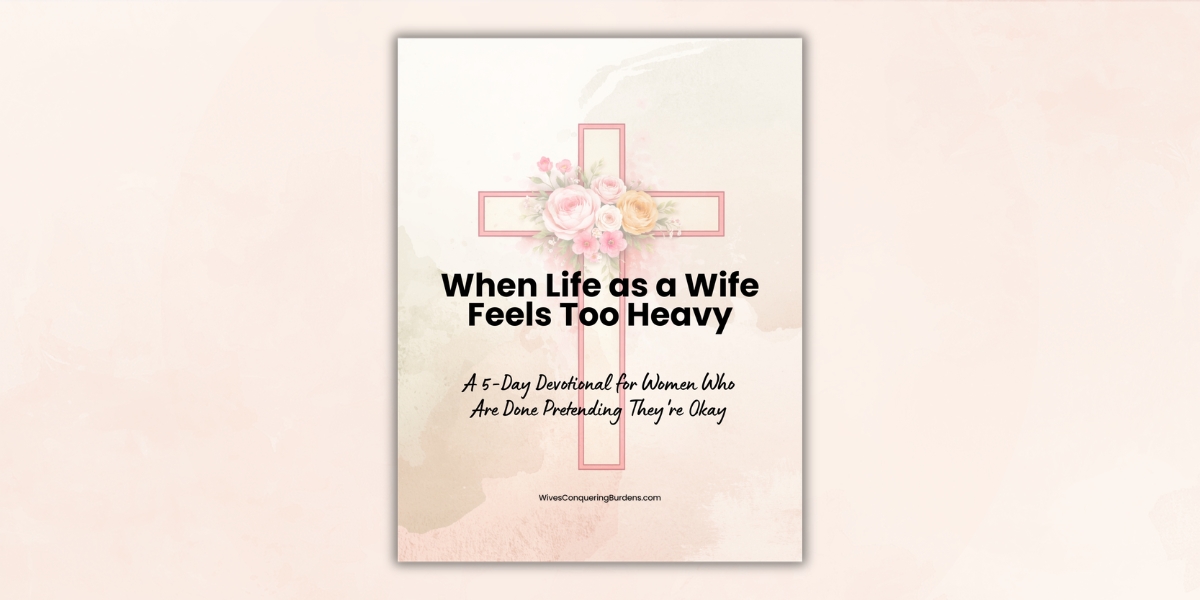
If this resonated with you, grab my free 5-day devotional When Life as a Wife Feels Too Heavy — designed for Christian wives who need to get quiet enough to hear God again.