

Why Toxic Marriages Are Not Just Hard Seasons (And How to Tell the Difference)
Watch the full video version of this teaching on YouTube.
What’s the difference between a rough patch and a toxic relationship?
You’ve probably said it to yourself more times than you can count.
“Every marriage goes through hard seasons.”
Maybe someone else said it to you. Your mom, your pastor, a friend trying to be helpful. And maybe it’s true. Maybe this really is just a season.
But maybe, and I want you to sit with this for a second, maybe you’ve been calling it a season for three years. Or five. Or longer than you want to admit out loud.
Somewhere underneath the hope that it’s “just a season,” there’s a quieter voice asking: what if it’s not?
That question is terrifying. Because if it’s a season, you wait it out. But if it’s not a season, if this is the pattern, then waiting isn’t the answer anymore.
Today I want to help you tell the difference. Not so you can panic. Not so you can make a decision today.
But so you can finally stop living in that confusing, exhausting space between “maybe it’s just hard” and “something is actually wrong here.”
Because that space, that not-knowing, is its own kind of exhausting. And you deserve some clarity.
What a Hard Season Actually Feels Like

Before we talk about toxic, let’s paint a picture of what a genuinely hard season looks like, so you have something to compare against.
Maybe you’ve lived through one of these. A new baby and you’re both running on no sleep and snapping at each other over nothing. A job loss that put a financial strain on everything and tension followed you into every conversation. A health crisis that consumed all your energy and left nothing for each other.
In seasons like that, something specific happens: you’re both struggling, but you’re still on the same team.
You might be irritable. You might argue more. You might feel disconnected for a while.
But underneath it, there’s still a sense of we’re in this together. We’re both tired. We both want this to get better.
And here’s the key marker. A hard season has an end.
The baby starts sleeping. The job situation resolves. The health crisis passes or you adjust to a new normal.
And when it does, you look back and you can see it for what it was, a hard chapter, not the whole story.
If what you’re living in matches that description, even if it’s been going on for a while, that might genuinely be a hard season.
And hard seasons, as hard as they are, are part of being married to another human being.
But what I want to talk about next is different. And I think, if you’re honest, you already know it’s different.
What Makes Something Not a Season

Here’s what I want you to notice about the story I just told.
You’ve probably been telling yourself a version of that story for a long time. “We’re just going through a hard time. Once this gets better, we’ll get better.”
But what if the “once this gets better” part never actually arrives? What if you’ve been waiting for the season to end, but there’s no actual season to point to?
No baby, no job loss, no health crisis. Just this. Day after day. Year after year.
That’s the first sign you’re not in a season. You can’t name what the season is.
A real hard season has a cause. You can point to it. “We’re struggling because of X.” If you can’t finish that sentence, if the honest answer is just “because this is how he is,” that’s not a season. That’s a pattern.
Here’s the second sign. In a hard season, both people are struggling together. In a pattern, one person is the source of the struggle and the other person is absorbing it.
Think about it. When you’re both exhausted from a newborn, you’re both exhausted. When one person is consistently the reason the house feels tense, when his moods dictate the entire emotional climate of your home, that’s not two people going through something hard together.
That’s one person creating the weather, and you living inside it.
Third sign: a hard season doesn’t require you to manage someone else’s emotions to keep yourself safe.
In a genuinely hard season, you might both be short-tempered. But you’re not walking on eggshells around each other in the same way.
You’re not calculating his mood before you bring something up. You’re not strategizing how to phrase things so he doesn’t react badly.
If you’ve developed a whole internal system for managing him, that’s not the normal friction of a hard season. That’s what happens when you’ve adapted to something that isn’t safe.
And the fourth sign, maybe the most important one: in a hard season, things eventually get better on their own, or with effort from both people. In a pattern, nothing changes no matter what you do.
You’ve probably tried things. Communicating better. Praying more. Going to counseling. Reading the books. Changing how you respond.
And maybe some of those things helped for a little while, but the underlying pattern always comes back.
That’s not because you haven’t tried hard enough. It’s because you can’t fix with effort what was never a “hard season” problem to begin with.
Why This Distinction Matters

I know what some of you might be thinking right now. “Okay, so what if it’s not a season, what does that even change? I still have to live here. I still have to figure out what to do.”
I hear that. And I’m not going to pretend that naming this magically makes anything easier in the short term. In some ways, it might make things harder, because once you see it, you can’t unsee it.
But here’s why this distinction matters anyway.
When you believe you’re in a hard season, your strategy is to wait it out. To survive until it passes. To keep doing what you’re doing because eventually, eventually, it’ll get better.
But if it’s not a season, if it’s a pattern, then “waiting it out” isn’t a strategy. It’s just enduring. Indefinitely. With no end point.
Part of why this matters so much is spiritual. Because when you think you’re in a season, your prayers probably sound like: “God, help me get through this. God, give me strength to endure until things change.”
But what if the prayer that’s actually needed is different? What if it’s not “help me endure” but “God, show me what’s actually true here. Help me see clearly. Show me what You want me to know.”
Those are different prayers. They come from different places. And they open the door to different things from God.
“Help me endure” keeps you in survival mode, which is the very thing that makes it hard to hear God clearly in the first place. “Show me what’s true” is an invitation. It’s you telling God you’re ready to see clearly, even if clearly is harder than the fog you’ve been living in.
What God Says About Patterns vs. Seasons

So what does God actually say about this?
One of the most overlooked things in scripture is how much God cares about discernment. Not just obedience. Discernment. The ability to actually see what’s true.
Proverbs is full of this. “The simple believe anything, but the prudent give thought to their steps.” Discernment isn’t a lack of faith.
It’s actually a form of wisdom that God repeatedly calls His people toward.
And here’s something important. Nowhere in scripture does God ask you to call something “a season” when it isn’t one. Nowhere does He ask you to pretend a pattern is temporary when it’s been the same for years.
In fact, scripture is full of God naming things accurately, even when the truth was hard. The prophets didn’t soften what they saw. They named injustice as injustice. They named unfaithfulness as unfaithfulness.
They didn’t call it “a hard season for the nation of Israel” when what was actually happening was a pattern of harm that needed to be addressed.
God’s people were never called to euphemisms. They were called to truth, even uncomfortable truth, because truth is what allows for real change, real repentance, or real clarity about what comes next.
If you’ve been calling something a season because the word “pattern” feels too final, too scary, too much like it’s asking something of you, I want you to hear this gently: naming something accurately is not the same as deciding what to do about it.
You can call a pattern a pattern and still take all the time you need to figure out what comes next. Naming it doesn’t obligate you to anything except seeing clearly.
And seeing clearly is something God consistently invites His people toward, not away from.
What to Do With This Clarity

So if you’ve made it this far, and somewhere in this you recognized your own life, what do you do with that?
First, give yourself permission to stop performing the word “season.” You don’t have to announce this to anyone. You don’t have to change anything today.
But internally, you can stop telling yourself a story that doesn’t match what you’re actually living. That alone is a form of relief, even if it doesn’t feel like it yet.
Second, bring this specific question to God. Not “help me endure.” Try: “God, help me see this clearly. Show me what’s actually true here, and help me trust what You show me.”
That’s a prayer that invites discernment instead of just asking for strength to keep going.
Third, write down what you’re noticing. Patterns are easier to see in writing than they are in your head, where they get tangled up with guilt and hope and fear all at once.
Even a simple list, here’s what’s been happening, here’s how long it’s been happening, can help you see what you’ve been living with more clearly than just thinking about it ever could.
Fourth, remember that clarity is not the same as a decision. You can know something is a pattern and not be ready to do anything about it yet. That’s okay.
Clarity isn’t a deadline. It’s just truth. And truth is always a safe place to stand, even when you’re not sure yet what comes next.
You don’t have to solve everything today. You just took a step toward seeing clearly. And that matters more than you know.
A Prayer for You

Father, I pray for the woman who has been calling something a season for far longer than a season should last.
God, give her the courage to see clearly, not so she has to act today, but so she can stop carrying the confusion of not knowing what’s actually true.
Help her bring You the real prayer, not just “help me endure” but “show me what’s true.” And give her the trust to believe that You will answer that prayer gently, in Your time, in a way she can handle.
Remind her that naming something accurately is not betrayal. It’s not giving up. It’s just truth, and truth is always safe with You.
In Jesus’ name. Amen.
Your Next Step

If this helped you see something more clearly today, even if it’s something you’re not ready to do anything about yet, I want you to take the next step.
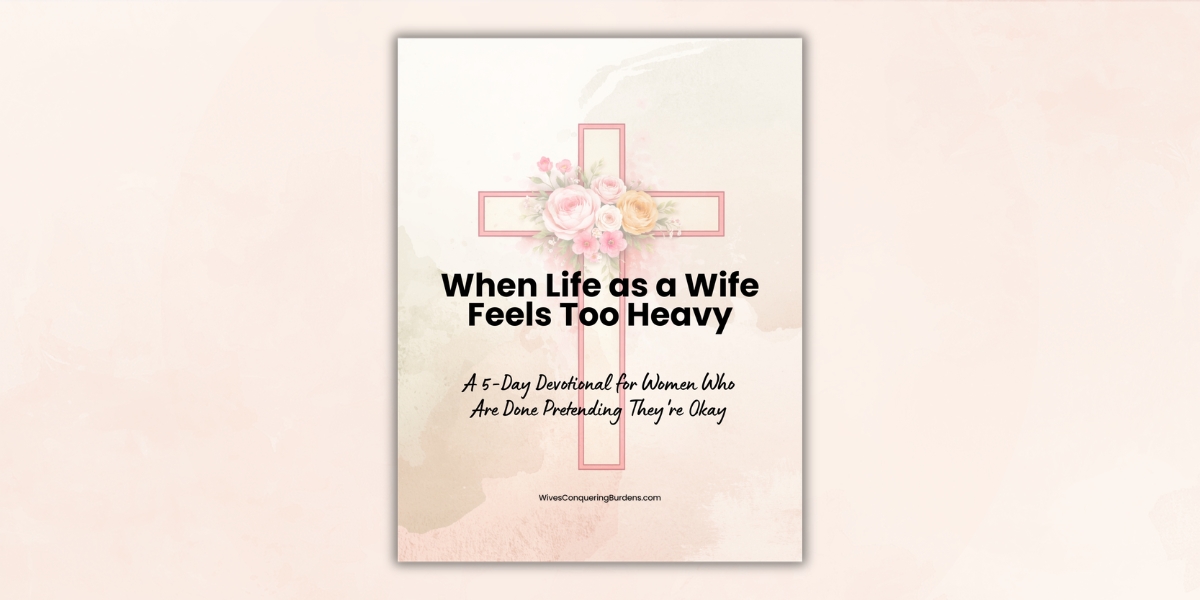
I have a free 5-day devotional called When Life as a Wife Feels Too Heavy. It’s designed for Christian wives who need to get quiet enough to hear what God is actually saying about their situation, clearly, gently, and at their own pace. Grab it here.
Five days. One topic at a time. Completely free. You don’t have to solve everything today. You just have to be willing to see clearly.
If this one hit home, these will too: