

Why God Allowed a Narcissist in Your Marriage
Why did God allow a narcissist in you marriage?
You prayed before the wedding. You remember exactly where you were when you asked God for wisdom about him, maybe in your car, maybe on your knees in your bedroom, maybe just a quick prayer between wedding errands because you were so sure it didn’t need more than that.
You thought you got a yes. Everything felt like confirmation. The way he talked about faith. The way your family loved him. The way it all seemed to line up so cleanly you didn’t think to question it further.
And now you’re standing in a kitchen you don’t feel safe in, replaying that prayer over and over, wondering if God missed it. Or worse, wondering if He saw it coming and let you walk in anyway.
This post isn’t going to tell you it was a test. It’s not going to tell you he’s your “assignment,” like you’re stuck completing a task with him as the obstacle course God handed you to climb over.
That language has been used for years to keep women stuck in dangerous marriages, dressed up as spiritual maturity. We’re not going to use it here.
But here’s what’s true: pain you didn’t choose is not the same as a purpose you don’t have. Those are two very different sentences, and by the end of this post, I want you to know exactly why that distinction matters so much.
Watch the full video version of this teaching on YouTube.
What Scripture Actually Says

A lot of what you’ve absorbed about this probably didn’t come from the Bible directly. It came from someone’s interpretation of the Bible, filtered through what kept a family, or a church, looking a certain way from the outside.
Nobody sat you down and read you the actual verses. You just absorbed the atmosphere around them.
So let’s go to the actual text. James 1:13 is direct and unambiguous: God doesn’t tempt anyone with evil, and He is not its source. Not the fine print, not a footnote, the plain statement.
Your husband’s narcissism, the manipulation, the control, the way he twists a conversation until somehow you’re the one apologizing for something he did, that’s his character. Formed by his choices, his patterns, maybe his own unresolved woundedness.
But it’s his.
Not God’s assignment. Not a curriculum God designed and handed to him to deliver to you like a lesson plan.
Genesis 50:20 gives us the clearest picture in all of Scripture of how God actually works in the middle of what other people choose to do.
Joseph’s own brothers sold him into slavery out of jealousy and hatred. That was evil, plain and simple, and God did not cause it, He didn’t need it, and He didn’t orchestrate it.
But years later, after everything Joseph went through, he says to those same brothers: “you
meant evil against me, but God meant it for good.”
Notice the order of that sentence carefully. They meant evil. God worked good into it, after the fact, in the wreckage.
Those are not the same action, and the distance between them matters enormously. God didn’t need their evil to accomplish His purpose in Joseph’s life. He redeemed the aftermath of a choice He never authored in the first place.
So what does all of that actually mean for your marriage, practically? What is God specifically doing in the middle of what your husband is doing to you right now?
What God Is Actually Doing

Here’s what tends to show up, over and over, in women living through exactly your situation, the pattern I’ve watched repeat itself again and again.
First, He’s teaching you to hear His voice over a manipulator’s voice. Think about what that actually requires of you.
Every single time your husband reframes what happened, insists that’s not what he said, that you’re remembering it wrong, that you’re overreacting to something small, you’re being forced to develop a skill most people never have to build on purpose: telling the difference between truth and a lie dressed up as love, dressed up as concern, dressed up as “I’m just trying to help you see this clearly.”
That skill doesn’t disappear once this season of your life ends. It protects you for the rest of your life, in every single relationship you’ll ever have going forward, with your kids, with friends, with anyone who ever tries to blur a line you should be able to see clearly on your own.
Second, He’s stripping away your performance, whether you’ve noticed it happening or not. You cannot fake peace living where you live.
You’ve probably tried, smiling through church, saying “we’re fine” at the family dinner table, posting the picture that tells a story your actual house doesn’t tell. But that performance has a shelf life, and yours is running out faster than you’d like to admit.
So either you find a real relationship with God, one that isn’t dependent on your circumstances looking okay from the outside, or you break trying to keep the show running.
That pressure, uncomfortable as it is, is actually pushing you toward the real thing instead of letting you settle for the performance of it.
Third, He’s showing you exactly who you are apart from his approval.
Every time your husband tells you you’re too much, too sensitive, not enough, too emotional, too dramatic, and you survive that moment without collapsing into believing it completely, you’re learning something most people never have to learn on purpose.
Your worth doesn’t come from his mouth. It never did. It was never his to assign in the first place, and every time you survive one more of his verdicts about who you are, you’re proving that truth to yourself a little more solidly than before.
The Difference is Crucial

Now here’s where I need you to slow down with me, because this next distinction is really the whole point of everything I’ve said so far.
This isn’t “God put him there to grow you,” as if your husband is a piece of spiritual gym equipment God assigned specifically for your character-building workout.
That framing quietly puts the responsibility for his sin onto God’s plan, and it lets your husband off the hook completely, as if his choices were just props in the story of your growth, rather than his own moral failures with real consequences.
Here’s the far more accurate sentence: your husband made his choices, and God is redeeming the wreckage those choices caused, in you, not through the excuse of him.
Say that difference out loud if you need to hear it in your own voice. “God is not causing this. God is redeeming what this cost me.”
Those are two entirely different theological statements, and only one of them is actually biblical.
And here’s what follows directly from that, if you really let it sink in: you are not required to stay in the wreckage to prove you learned whatever lesson you think you’re supposed to be learning.
God doesn’t need you in danger to finish His work in you.
If you leave tomorrow, God doesn’t lose access to you. He’s not sitting somewhere in your marriage waiting for a specific graduation date before He’s allowed to keep working in your life.
He works in you wherever you are, married, separated, divorced, safe, still figuring it all out. The
work was never contingent on the danger continuing.
Where This Leaves You

So where does all of this actually leave you, practically, today?
If you’re still here, still in it, still surviving it, still praying quietly in the car before you walk back inside the house, that’s not failure.
That’s not weakness. That’s not you failing some spiritual test everyone else around you seems to be passing effortlessly. That’s God meeting you exactly where you currently are, doing something in you that no comfortable, easy marriage ever could have accomplished.
The clarity you’re gaining right now about who you are, and Whose voice you actually trust, is something most women never have to fight this hard for.
And if you’re already gone, if you left, or you’re in the process of planning to, that’s not you skipping the lesson. That’s not you running away from what God was doing in your life. You don’t get demoted in your relationship with God for choosing safety.
Nowhere in Scripture does God reward a woman for staying in danger longer than
she needed to, just to prove her faith was somehow more real.
Either way, still in it, or already out, the purpose was never the pain itself. The purpose is what God is doing with you in the middle of it, and that work follows you no matter what you decide to do next.

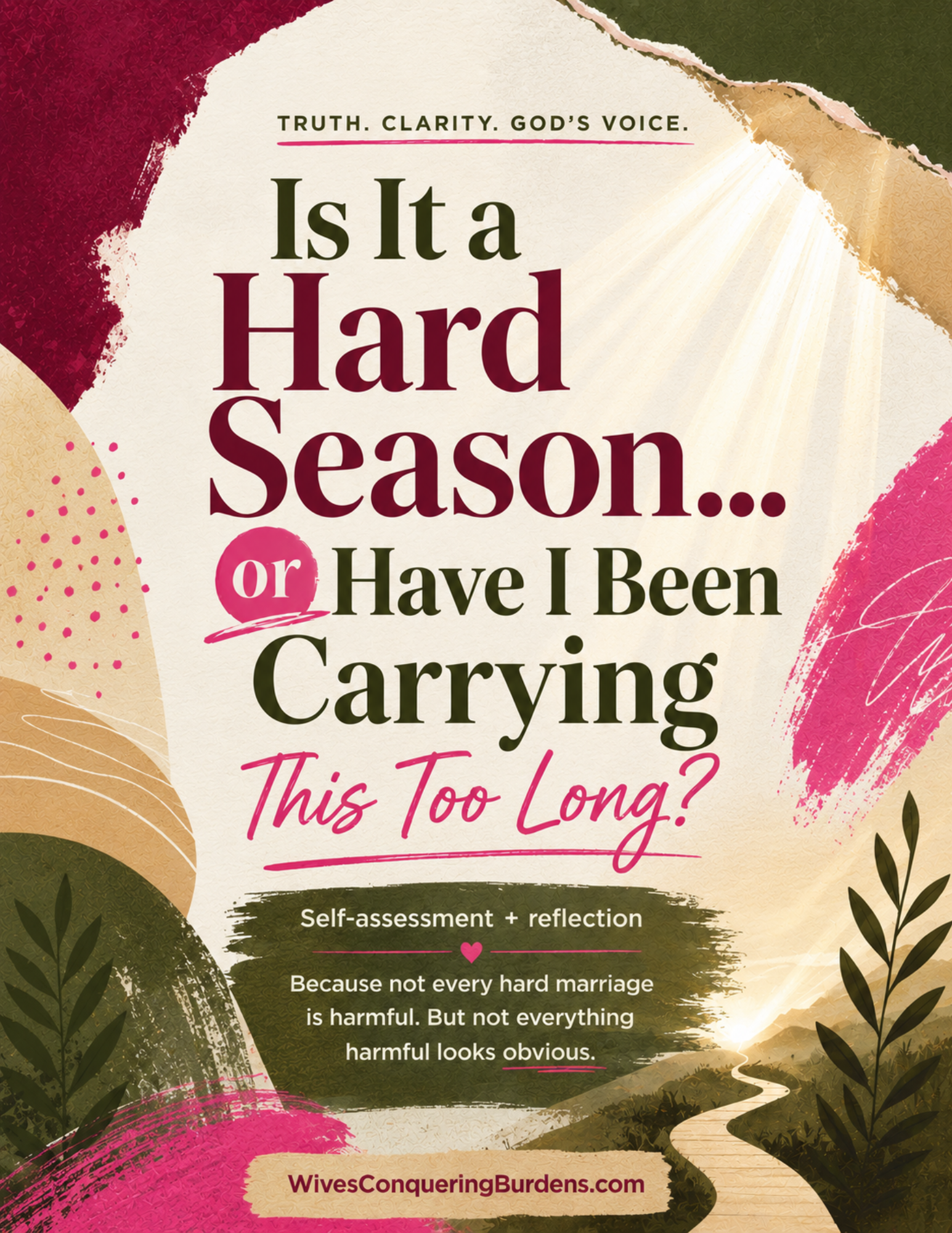
If you need language for what’s happening in your home, something to help you name it clearly instead of doubting yourself every single day, grab the free guide: Is It a Hard Season or Have I Been Carrying This Too Long?
If this one touched you, take a look at these ones too: